1. Radar Mounting
There are several important factors that need to be taken into consideration when mounting the radar, including (but not limited to):
- Mounting Height
- Mounting Angle
- Mounting Position
These factors help to ensure that the MAX-SAFE system works to the highest level of safety.
The correct mounting of the radar will ensure the effective operation of the MAX-SAFE Reverse Watch 2.0 solution. If any of these factors are incorrect, the radar will be prone to causing the MAX-SAFE Brake system to operate in an overly sensistive manner, such as over braking.
2.1 Mounting Height
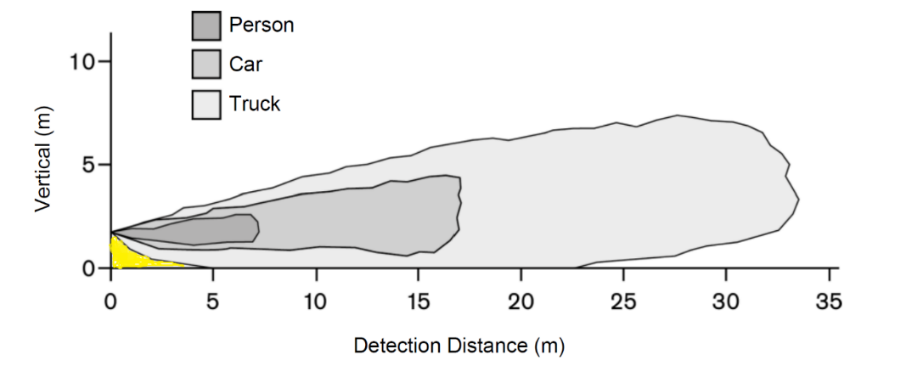
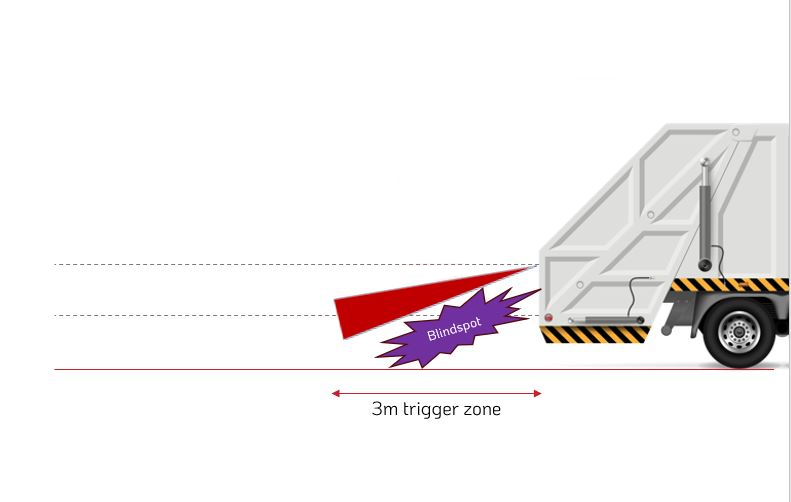
The height at which the radar is mounted has a significant impact on the close proximity effectiveness of the object detection. The lower the radar is mounted; the better detection of objects close to the back of the vehicle. As the height increases, a gap in the detection zone appears (see depicted in yellow on Figure 1, below):
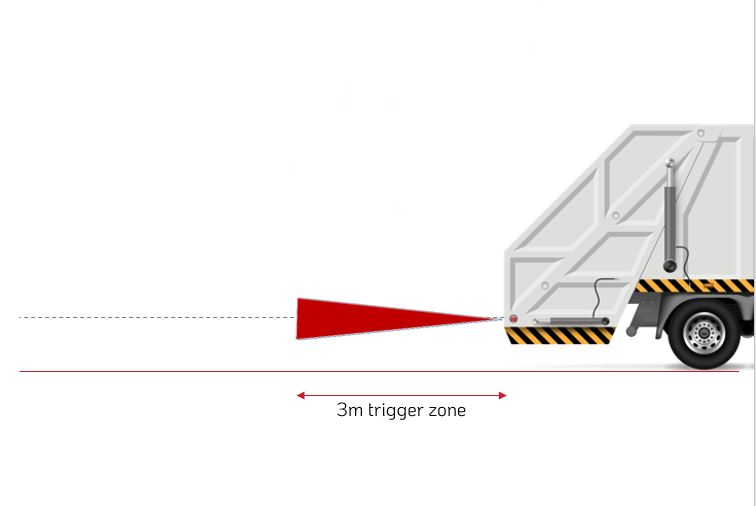
The recommended mounting height for the radar is 700mm, with the mounting angle 9° upwards.
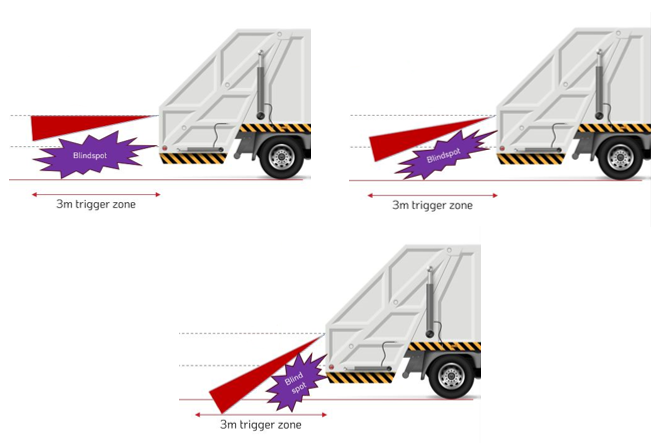
If the radar is mounted too high, the effect is that it causes a blind-spot in the detection zone at the rear of the vehicle, as seen in the images below.
2.2 Mounting Angle
The angle with which the radar is mounted is another important factor in the effectiveness and driver usability of the system. A typical notion is to point the radar in a downward direction, such as pointing directly at the ground. This is, however, an incorrect mounting of the radar. The table below provides the reference for the appropriate angle to mount the radar. Keep in mind a low radar mounting height gives optimum performance and less false triggers.
Installation height on vehicle (to sensor centre point) | Adjustment angle in upward direction from the horizontal plane | |
[m] | [in] | [°] |
0.5 | 20 | 11 |
0.7* | 28 | 9 |
0.9 | 35 | 8 |
* Recommended mounting height
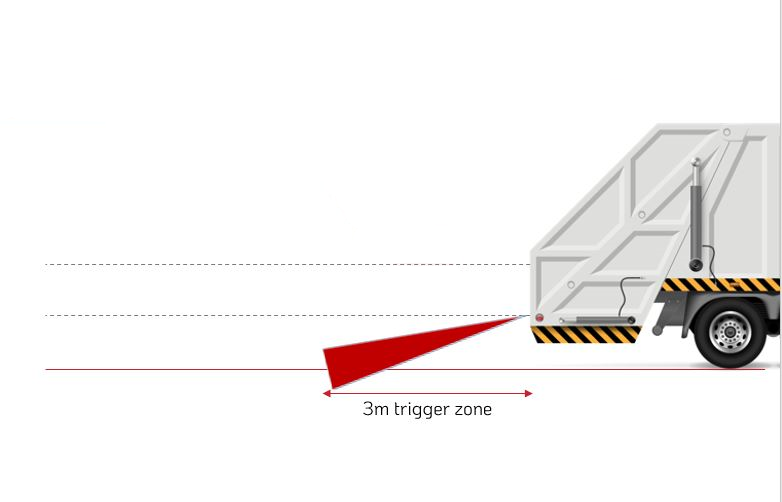
If the radar is angled down, this may cause the system to trigger frequently as it points onto the road. The ramifications are that the overly sensitive system causes the driver to use the override feature constantly and by default, instead of only when needed. This cultivates complacency and bad habits, as well as not trusting the system. Examples of incorrect radar angles are seen in the images below.
2.3 Mounting Position (relative to centre of vehicle)
In the recommended locations, the radar sensor is mounted off the chassis or body and tucked slightly under the body. The radar should be mounted in the centre of the vehicle with the detection beam uninhibited by any objects.
Note, the radar can also be mounted off the centreline, and any adjustment to its mount can be configured in the system settings that compensate for an off-centre or slightly obstructed mounting position. However, the system may have reduced safety in these circumstances. Please contact MAX-SAFE Support for further assistance.
The radar should be mounted to avoid detection of any overhang or objects on the vehicle, i.e., the radar should have a clear line-of-sight to the detection zone without any parts of the vehicle body or objects obstructing it. Any such objects will potentially. The beam of the radar has a 120° horizontal angle and a vertical angle of 20°.
2.4 Recommended Sensor Mounting Locations
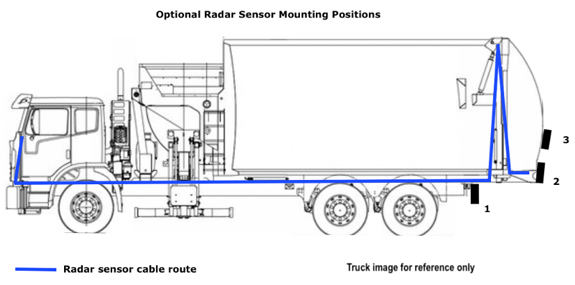
Depending on vehicle application and customer requirements the sensor can be mounted in different locations. As highlighted in the sections above, each location has its advantages and disadvantages. The examples provided are for a garbage truck body, but the same principles will apply to all body types.
2.4.1 Sensor Location 1 (Recommended Location)
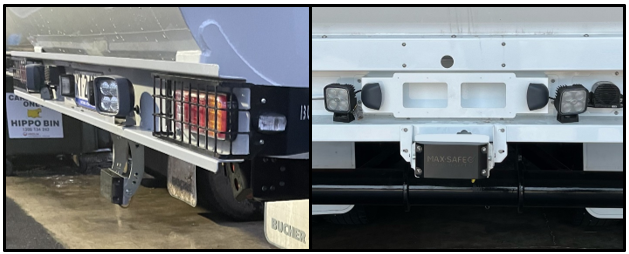
In this position (see Figure 5), the radar sensor is mounted off the chassis or body and tucked slightly under the body. The advantage of this location is that there is minimal blind spot in the detection zone (see section 2.1 Mounting Height), minimising the risk of asset or infrastructure damage, OR serious injury or death.
Additionally, the sensor mounting angle can be mirrored and fine-tuned to reflect the manufacturer’s recommendation (see 2.2 Mounting Angle). Other advantages of this location are that the sensor is less likely to detect the road when reversing out of steep driveways, and also that the cable does not need to be run over the body hinge point.
However, this mounting position does have disadvantages as well. In this position, if the vehicle pushes back into a low object, such as a dumpster or rubbish pile, the sensor can be damaged. Additionally, some ghosting may be experienced from the body overhang. The sensor can be programmed with blind spot regions to mitigate this, however.
2.4.2 Sensor Location 2
In this position (see Figure 5), the radar sensor is mounted on the rear of the body, with the light bar. This mounting position increases the gap in the detection zone (as explained in section 2.1 Mounting Height). An increase in the detection zone gap increases the risk of asset or infrastructure damage OR serious injury or death, and so, this sensor mounting location is NOT RECOMMENDED.
2.4.3 Sensor Location 3
In this position (see Figure 5), the radar sensor is mounted on the rear bowl of the body. This mounting position SIGNIFICANTLY increases the gap in the detection zone (as explained in section 2.1 Mounting Height). An increase in the detection zone gap increases the risk of asset or infrastructure damage, OR serious injury or death; therefore, a mounting position greater than 1.3m to the centre of sensor from ground level is NOT RECOMMENDED.
3. Radar Programming
The radar used in the MAX-SAFE Reverse Watch® 2.0 system is programmable, to allow for various parameters to be adjusted for specific applications. The radar trigger position must be, at minimum, 3m from the rear of the vehicle body.
The radar unit shipped with the MAX-SAFE Reverse Watch® 2.0 system is typically programmed with the width set at 2.6 metres, with a trigger point of 3m, and a detection distance of 5m. This means that the driver will receive 2 zone warning lights (Green 5m-4m, and Yellow 4m-3m) before the Reverse Watch® 2.0 radar triggers.
The radar settings and operation should be checked and modified to suit the vehicle application and sensor fitting location. The height, angle, and position of the radar may require the default settings to be adjusted. The useability of the system may be affected.
3.1 Programmable Radar Parameters
The programmable parameters of the radar include:
Width of Vehicle
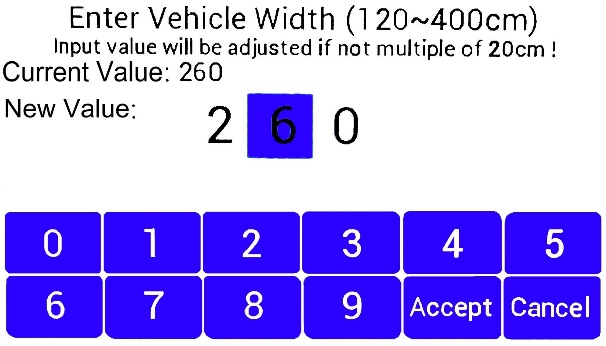 The sensor is typically set to a width of 2.6m. This helps ensure that the system does NOT trigger as it passes objects that are outside the width of the vehicle. The width value can be set between 120cm and 400cm.
Blind Spot Zone
Depending on the placement of the radar sensor, such as if the sensor were placed on the chassis with an overhang of the body present, the blind spot zone may need to be reprogrammed.
Trigger Distance
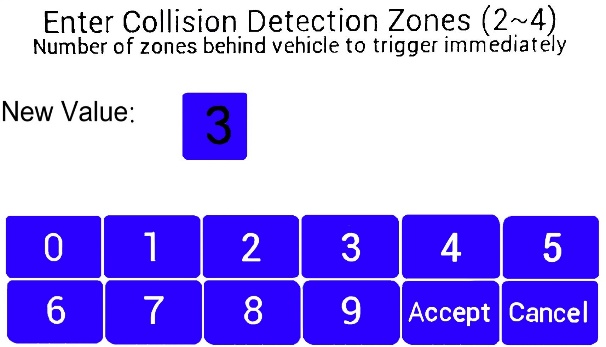 This setting is the distance from the sensor at which the radar will signal to the Reverse-Watch® unit to apply the brakes.
The Collision Detection Zones are the zones in which the radar alerts the driver to objects at the rear of the vehicle, with the default zone set at 3m (zone factory set).
The following needs to be kept in mind when determining the parameters of the Trigger distance setting:
- The travel speed of the vehicle. At 5km/h, for example, the vehicle travels approximately 1.4 meters per second. The radar unit has a response time of approximately 0.3 seconds or less.
The Reverse Watch® 2.0 radar will trigger within 100 milliseconds of receiving the signal from the radar. However, the pneumatic delay from the spring-brake when applying brakes will be different between vehicles.
Considering the above; the request to brake could be, in the worst case, as much as 0.6 seconds after the object reaches the set trigger point, within which the vehicle will have travelled approximately 0.84m, leaving the vehicle braking system 2.1m to stop the vehicle. A vehicle with a slow park brake application may need the trigger point set at a higher distance than the standard 3m setting. This is also the case if the sensor is located on the chassis, as the distance from the sensor to rear of body will need to be added onto the standard 3m setting.
Was this article helpful?
That’s Great!
Thank you for your feedback
Sorry! We couldn't be helpful
Thank you for your feedback
Feedback sent
We appreciate your effort and will try to fix the article